
Please check out the new site at devinwired.com.
Today marketers have access to boat loads of data. They can obtain anything from brand impressions your marketing channels have collected all the way to how many conversion actions have been completed on your site.
Regardless of how much data you have it doesn’t matter unless you leverage the data correctly to continually increase the performance of your marketing efforts. The ultimate goal to reach your target consumer better at a more efficient price is now truly becoming possible. In the past I have written about ZMOT, the idea that consumers today have an increased understanding of the digital space and often don’t complete conversion activities after viewing your site the first time (read more about ZMOT). With recent advancements in digital reporting suites such as Google Analytics we can pin point the value each marketing channel brings to our marketing mix. This goes beyond the eye of standard reporting with KPI’s such as CTR (Click-through-Rate) and impressions and focuses more on channel ROI.
Marketing channel attribution is the process of pinning a value to each interaction a consumer has with a marketing channel. The first step is to determine all of the channels you have, organic and paid. Once you have captured all of your digital and traditional channels in your analytics account it is time to start developing your attribution model.
There are many marketing attribution models available for marketers to leverage, but I personally believe your model needs to be adjusted to best fit your business objectives. As you all know I am a major Google fan boy so I will review the five main attribution models Google has recently released to the public.
EXAMPLE: A consumer discovers your brand by clicking through to your site from a paid online display ad. The consumer checks out your site and leaves without completing a conversion. Then two days later the same consumer searches for your brand in Google and clicks through to your site. The user while on your site signs up for your CRM email program and leaves again without completing a purchase transaction. One day later the same user receives an email from your CRM program and clicks through to your site from the email where they end up completing a transaction (conversion).
Last Interaction
This model is traditionally how most marketers have judged effectiveness of their marketing efforts. It is when the last channel used to complete a transaction gets all of the credit for the conversion. – In this example the paid email program would receive 100% of the credit.
First Interaction
This model gives 100% of the credit to the first channel that directs users to your site. – In the case above the paid display ad receives 100% of the value.
Linear
Each channel assisting in the conversion path receives an equal distribution of weight. – Paid display, organic search and email would all receive equal credit at 33% each.
Time Decay
In this model the channel closest in time to the final conversion transaction would receive the most credit. The total percentage of credit would decrease based on how much time has gone between the channel interaction and the conversion event. This model takes some additional effort to determine how you want to allocate points based on the time passed – Lets apply a simple Time Decay model to our example that attributes 50-30-20 at a 3 day transaction with a 5% shift for every day delayed. In our example each channel would be allocated the following:
- Email 50%
- Organic Search 40%
- Display Ad 10%
Position
This assigns a different value based on when the user interacts with a channel. The Position model has the most lenience allowing for you to adjust it to meet your unique business objectives. – Lets apply a simple model again to our example. Lets say the first interaction in worth 40%, middle interactions split 30% and the final interaction is allocated 30%. In our example the display ad gets 40%, organic search receives 30% (note if more channels in-between first and last interaction the 30% would be split between them) and the email channel receives 30%.
There are many different ways we can slice this pie, but it is important you understand the core models to develop an effective attribution model for your business. I would like to thank the Google Analytics team for making industry breaking strides in this space over the past year. Google has developed a great section on how to develop attribution models and how you can leverage Google Analytics to make these a reality. Please check out the articles and how-to guides at the link below!
https://support.google.com/analytics/bin/answer.py?hl=en&answer=1662518&topic=1191164&ctx=topic
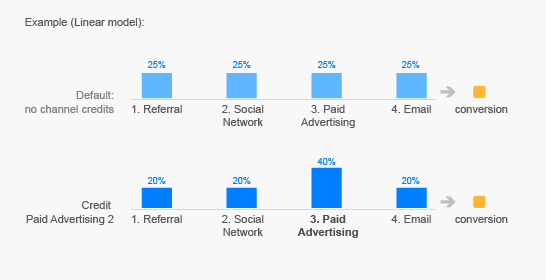
Google Analytics Linear Example

This infographic is a little outdated but it can be used as a great refresher for anyone who doesn’t know how Facebook advertising was started.
Source: Mashable
Key Performance Indicators or better known as KPIs are metrics measured throughout a campaign to judge success. Many marketers blow through this stage of planning which is a huge mistake. It is essential before considering any creative or media elements to a campaign that KPIs are set. KPIs should be a measurement that helps accomplish solid business objectives. If its increasing e-commerce sales or increasing the number of users who engage socially with your content, having these objectives will be able to help you decide which vehicles and partners are the most effective.
As you may have noticed above every time I mentioned Key Performance Indicators there was an “S” added, meaning plural! No mater what type of site you have there will be multiple elements you can measure. You may prefer to establish one master KPI on your site that the campaign was initiated to accomplish, such as increased sales of a particular product. There could potentially be many other KPIs set that support that top-level goal. An example for a site that sells movie tickets: newsletter sign-up, social share, watch a movie trailer or search for map directions. All of those would help support the overall business goal of selling more movie tickets.
There is a lot of analysis that is involved with determining how different KPIs help achieve an overall business objective. My suggestion for you is track everything across multiple channels and through analysis determine how each plays a role in your conversion process. KPIs will help you improve future campaigns and will demonstrate to clients/managers that their marketing dollars are producing measurable results.
Display advertising today is driving sales for some of the biggest and smallest brands. The online channel has evolved today to become an extremely strong tool to reach your target consumer online. To really understand the value of display ads a marketer must learn about the unique ways it can leverage the channel to meet its consumers needs. In this post I am going to focus on a personalized form on display advertising, called retargeting.
Retargeting is truly a basic concept . It allows brands to serve display ads only to those people who have visited their website or other online owned property. Most brands only leverage this technology to enhance their standard display ad campaigns. This will prove to be more effective than standard display ads but it doesn’t even come close to the power of retargeting.
Retargeting should be used for valuable online objectives: reduce customer drop-off, fight to obtain ZMOT (Zero Moment of Truth),
If your site has any type of process involving steps the online consumer has to complete, you know there is a significant amount of customers who stop during the middle of the conversion process, called drop-off customers. Retargeting can be used to serve unique creative to consumers based on how far they made it through your conversion funnel. The customized creative will encourage them to repeat the process and complete the desired conversion. A great example that is used to encourage conversion from drop-off customers is cart abandonment ads. Cart abandonment is when a user visits a site and adds products to a cart but decides to leave the site without checking out the products in their cart. Display ad retargeting allows us to serve ads to the customer that include the products that were added to the customers cart but not checked out. The same methodology of cart abandonment display ads can be manipulated to best meet the needs of your conversion funnel. educate your customers about new offerings and encourage customer loyalty.
This was just one example of how you can use retargeting to meet your business objectives. Evaluate how you could use this unique technology to grow your online business and build your brand online.
This is a little out of context as a post for me but as I am always striving for innovation I though it would be a great idea to share. Taco’s are by far my favorite food. They are easy to make and you can add all of the spice your heart desires. The big problem with tacos is the difficulty in estimating how many ingredients (meat, cheese, onions etc.) should be prepared before the meal. At the end of a meal you have a couple of options: pack all the leftovers in little organized containers, power down another taco or make a delicious pile of chips filled with the leftover ingredients. As a single young professional who lives by himself; I don’t have enough Tupperware for the leftovers so I am typically forced to fall back on the option of powering it down #dontwastefood.
I ran into this predicament today after lunch with a co-worker where the ultimate decision of choosing another delicious taco or develop the leftover chip concatenation. After a couple of minutes debating the value of each choice, a co-worker and myself decided to kick our creative skills into gear. We developed the #Naco! It is a taco with nacho chips and all of the leftover ingredients from your taco fiesta.
Now many of you may be wondering how does this apply to marketing and innovation? It is ideas like this that make social opportunities for companies to leverage in branding campaigns. Think if Taco Bell (my favorite fast food) would develop a competition that allowed consumers to post and engage with new ideas for tacos. If the competition leveraged earned, owned and paid social elements it could be a great brand experience for consumers with massive reach. Make sure to keep an open mind and always be listening for your next opportunity to leverage consumer generated content to build your brand! If you have any innovative taco ideas please post them in the comments.
Here is a great info-graphic that demonstrates the main elements of search engine marketing(SEO).

Traditional television for years has been run on skeptical ratings to demonstrate performance. Now that the digital era has emerged and marketers have massive amounts of data very few people know what to do with the data. Digital tracking has allowed us to collect granular data that can be used to optimize campaigns during and after flight. The data many marketers use to attribute success is impressions, clicks and a combination of the two (CTR). I can tell you that if you have those metrics on your reporting dashboards you missed a major step in planning.

Before every campaign it is essential that you setup measurable conversion goals for your digital campaign. If it is submitting a form, purchasing a product or even just sharing a page throughout their social networks it needs to be something. Marketers should then set eye on optimizing and judging performance off of those conversion goals. A common metric to judge this is, CPA (cost per activity). This will help you to reflect ROI more effectively and contribute to having better performing campaigns.
In today’s world it is essential that you build an army of connections that are available to access when needed. I started building my network sophomore year of college and it still has a long way to go before I am satisfied. The truth is I don’t think I can ever be done because the space is always changing, allowing for new innovative opportunities to brand yourself. If it’s getting your first job or finding your next business partner personal branding can give you a super boost into the world of professionals. In my article I am going to cover all of your favorite social sites LinkedIn, Google +, Twitter, Blogs and how to develop a strategy that works for you.
You would think everyone by now who knows anything about anything has a LinkedIn, but many people are still missing a profile on this popular business networking platform. So how do I use LinkedIn? I use it to organize and connect with any professional I connect with on a somewhat meaningful level. Do not fill your LinkedIn connections up with a bunch of people you never intent to talk to again, it is not worth it.
Tip 1: Make your LinkedIn profile as public as you possibly can. The platform is for professional networking you should only be posting topics on your LinkedIn that you would be open to share with the world. On almost a weekly basis I run across someone I am trying to connect with on LinkedIn that requires some form of verification like a private email that prevents me from connecting.
Tip 2: Optimize your profile for Search engines and for LinkedIn recruiters. Most recruiters today are out searching on Google and networks like LinkedIn to discover new young motivated talent. By using a little search engine optimization (SEO) you can easily be found by people in your related industry. After your profile is public, fill in all the information utilizing specific keywords in your descriptions that make you more visible to the correct audience.
Tip 3: Follow companies and join groups that are in your same vertical. Engaging in these groups will not only increase your SEO but it will also allow you to network with people of like interests and may just lead you to your next career path.

Oh Google Plus how I love you so. All of you I’m sure are aware of Google’s new social network: Google Plus by now. Well if not, learn it because this will be an enormous part of how the internet is run in the near future. I could write a book on the cool things that are going to change in the future because of Google Plus and how Google is planning to use connections information but below are a couple of tips that can help you get started.
Tip 1: The great aspect of Google Plus is its advanced privacy controls. I would never suggest someone to make their Facebook profile public because there is not enough control but with Google Plus you don’t have a choice if you want to develop your professional network make yourself present publicly on this network. That doesn’t mean you can’t also use it for personal use, that is what makes it so great!
Tip 2: Google has developed their version of the Like button its called Plus One. All of your Plus Ones are tracked on your Google Plus Profile Page. Google loves people who engage with and share content, so make sure you plus one a lot. I would insist on hitting that Plus One button on all of your favorite industry sites and blogs. The more connected you are with unique interesting content the higher Google will rate you in its search algorithm.

Twitter is the micro blogging site that changed everyone’s life, who has the obsession with staying connected all the time. Regardless of what your personal thoughts on twitter are it is an awesome way to connect with professionals that you don’t know and a good way to stay connected with the ones you rarely see. On Twitter go and follow as many people as your heart desires to build your network as large as possible.
Tip 1: Connect with those professionals that you rarely see on twitter. When you see them tweet about an article reply back stating how you found the information helpful. This is the easiest way to maintain connections. Do be cautious though the more people you follow the more difficult it is to keep your feed clean.
Tip 2: Tweet popular articles, trending keywords and utilize hash tags at events. Honestly the way I have found to gain the most industry followers was by tweeting event #hashtags. It is an extremely easy way to connect with new people who have the similar professional goals and interests. You don’t even have to physically be at the event!
The next phase I believe that is going to replay itself on the internet is blogs. Blogs have been around for a long time but I believe that they are going to continue to squeeze their way back into the spotlight after being suppressed by Social Media 2.0. The need for new interesting relevant content will continue to rank higher and higher in search engines as an attempt to cut through the clutter and that is where blogs come in. Here are a couple of tips I would suggest for blogs.
Tip 1: Develop an attractive layout that showcases your creativity.
Tip 2: Share all of your blog entries with your social infrastructure you have built from the above suggestions. These will be most of your loyal followers in the beginning.
Tip 3: Write topics that are interesting and relevant to you. Unless you are personally benefiting from a blog it may not be worth the effort (it is a lot of work).
I hope you have found this post interesting and useful. If you are to leave this post with one major nugget of information please let it be: it’s no matter what platforms you are on make sure your look and positioning is consistent throughout. Developing that positioning strategy can make or break how many people are willing to connect with you. Also make sure to link all of your social sites together to cross promote your different social products. Just remember the earlier you start developing your social infrastructure the sooner you will be able to access it. Please feel free to write in the comments your opinions or personal branding success stories.
Devin Wyngard’s Google Profile
Make sure to check out the rest of my social profiles by clicking on the links in the upper right box by my picture!
Marketers over the past couple years have start to become overwhelmed with the amount of opportunities available in the digital space. It has taken many long hours of constant research and dedication for me to stay on top of the space that changes on a daily basis. Jim Lecinski and the team at Google have done an awesome job of ironing out and putting some framework behind the changes that are happening. Did I mention they also filled it with great research that you can leverage for upper level management proposals. Lets dive into a high level overview of this free 70 page eBook.

In the past marketers have looked at three main opportunities to entice consumers to make a purchase: Stimulus, First Moment of Truth (FMOT), and Second Moment of Truth(SMOT). Stimulus has been used by marketers since the beginning of mass media. It is that advertisement that initiates an action to entice a consumer to either find more information or go purchase a product. Proctor & Gamble coined the First Moment of Truth back in 2005 to describe the essential seven seconds after a shopper encounter a shelf filled with a bunch of products. That year Kevin Roberts also published a book called Lovemarks that explained FMOT and introduced Second Moment of Truth as the experience or level of satisfaction that a consumer has with a product after they take it home. Google is suggesting that there is an added step in this process called ZMOT, and I agree!
The Zero Moment of Truth is all online. It is that second when a consumer picks up a laptop and starts an online quest to find a good all the way to when they decide I want to purchase this product. According to Shopper Sciences report the average shopper uses 10.4 sources of information before making a purchasing decision and that number varies by vertical. ZMOT can be used to enhance the other moments of truth. In the eBook Jim discusses the in’s and outs of ZMOT and how your brand can better leverage search, ratings & reviews, display, mobile, social and more to enhance your presence in ZMOT. I suggest all of you read this book front to back so you can understand where your company or client’s ZMOT is. Below are some key stats that truly prove this theory and that you need to be on the leading edge with your ZMOT strategy.
- 79% of consumers use a smartphone to improve their shopping experience.
- Position is everything in a mobile search campaign. Your CTR can drop 90% by moving from that #1 spot to the #4 spot. Also mobile only campaigns perform 11.5% better on average than hybrid desktop-mobile campaigns.
- Over half of your in-store sales could be driven by your website. (bestbuy.com)
- The overlap between users that saw the same ad on TV and YouTube is only 1.9%.
- Over 50% of consumers comparison-shop online and over 60% search for deals.


